
Cram It All In
Explore our dramaturgy site for The Greatest Play in the History of the World.
Click the topics below to expand them and learn more — about space, love, and what your fellow audience members would put on a new Golden Record.
Voyager
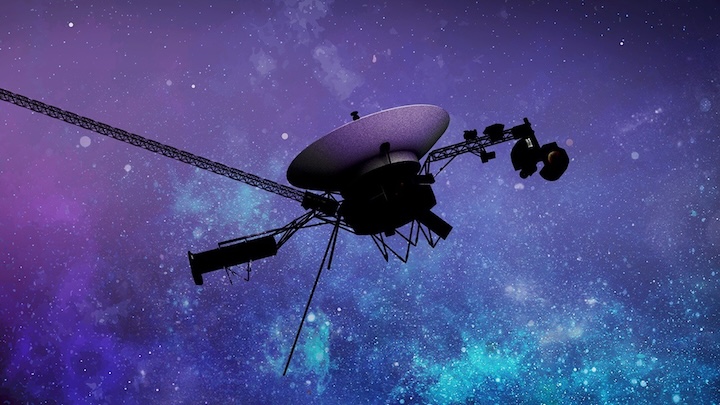
The Voyager probes’ primary goal was to study Jupiter and Saturn and their moons. This was made possible by a rare alignment of the four giant planets at the outer rings of the solar system, as both the relatively close distances and their gravitational fields could help propel the crafts. This would only be possible every 175 years — the universe literally needed to align for this mission to happen.
Voyager 1 was launched September 5, 1977, from Cape Canaveral, Florida. It explored Jupiter, Saturn, and their moons before heading out to interstellar space, above the elliptical plane of the planets’ orbits. On its way out, Voyager 1 took the Pale Blue Dot image (more on that below!). Voyager 2 was launched August 20 1977, from Cape Canaveral, Florida. Despite launching first, it was on a longer flight trajectory and would reach Jupiter after Voyager 1 — hence the order of their names. It explored Jupiter, Saturn, Neptune, Uranus, and their moons before heading out to interstellar space, below the elliptical plane of the planets’ orbits.
By 1986, both Voyagers’ initial missions were complete. Scientists discerned that Voyager 2 could continue on to study Neptune and Uranus as well, while Voyager 1 could continue on to interplanetary space. They remote-controlled reprogramming updates to the crafts from Earth to make that possible; Voyager 2 completed those planetary studies in 1989 and then also continued on to interstellar space.
Both crafts have reached interstellar space (the area beyond the reach of our sun’s solar wind), becoming the first human-made objects to do so, and both will continue to move through space indefinitely, for millions or even billions of years. While most of their instrumentation has been turned off to save energy, both probes continue to send back data today, well past what scientists originally thought would be possible. In about 30,000 years, Voyager 1 will officially pass beyond our solar system; 10,000 years plus 1.7 light years later, it’ll encounter a star in Ursa Major.
Learn More:
Where are they now?: NASA’s real-time calculator of both Voyagers’ distance and trajectory
Golden Record
“It was a sacred undertaking because it was saying, ‘We want to be citizens of the cosmos. We want you to know about us.'” – Ann Druyan, Creative Director of the Golden Record
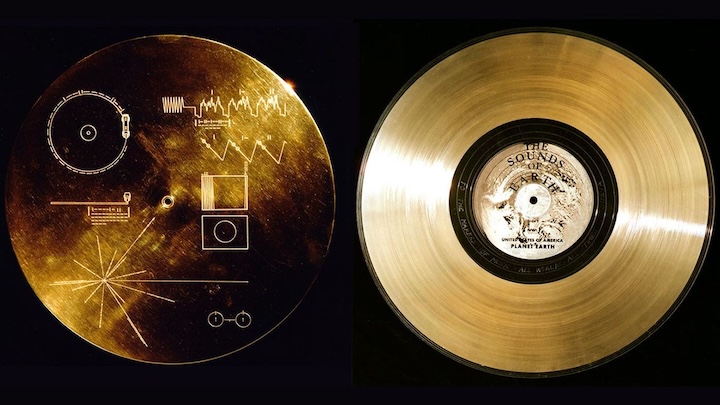
Pioneer, an earlier space probe, had a plaque that greeted extraterrestrials. For Voyager, NASA decided to go further than that with the Golden Records, meant to be a fuller depiction of life on Earth. The committee was chaired by Carl Sagan (more below!); its creative director was Ann Druyan. The committee included scientists like astrophysicist Frank Drake, artists like Linda Salzman, and ethnomusicologists like Alan Lomax to ensure all sides of the project were represented, and that a wide variety of world and cultural music would be included. A printed message from then-president Jimmy Carter was also included, saying “This is a present from a small, distant world, a token of our sounds, our science, our images, our music, our thoughts and our feelings. We are attempting to survive our time so we may live into yours.”
No one expected that extraterrestrials would find it quickly or even ever and come visit — it’s been described as a message in a bottle, a true leap of faith. It’s meant to be a greeting if someone were to find it, and if not, to be a record of our existence in all its complications for all time. The records have music, sounds, speech, and images on them, with a series of scientific drawings that indicate how it should be played. Both records are inscribed with “to the makers of music — all worlds, all times.”
There are 27 music tracks, featuring tracks from around the world, across genres and times. Ann Druyan was the creative director who took the lead on gathering the music; she tried to include a wide variety and to consider both what would tell a story about the varied tapestry of music on Earth and what artists deserved to live on in perpetuity. There are also more than 25 sounds — animals, car horns, laughter, a mother speaking to her newborn. Greetings were recorded in 55 languages; the committee made efforts to include the most-spoken languages globally alongside more ancient ones. Those speakers were given only the instruction to keep their greeting brief; content was up to them.
Learn More:
Listen to selections and see images from the Golden Record
All the greetings, translated
Listen to the Golden Record: All music and sounds and greetings
*****
What would you add to the Golden Record? Tell us your song, your sound, your image, your feeling, your anything at all.
Share your submission here, then click below to see what others said.
See Others' Golden Record Submissions
- Dvorak’s “Coming Home” as played by Yo Yo Ma on YouTube during the pandemic
- A baby’s laughter
- Rain in the forest
- The feeling of getting under a warm blanket with someone you love
- The feeling of my son as a toddler sitting on my lap with his head on my chest
- Lebron James
- A map of our wonderful world
- A wicked haiku
- My dog Callie
- How we almost won State
- Photos of all my animals
- Playing penguins with my mom while we wait for the bus
- A honeybee and a daisy
- My cats
- Monet
- The feeling of laughing with my sister
- My dogs Hazel and Daisy
- 62 Spaldeens
- Twinkle Twinkle Little Star and E=MC2
- The laughter of my children and grandchildren all together
- A collection of family recipes and their stories from around the world
- The sound of birds tweeting
- The sound of the ocean splashing against the shore
- The sound of my father whistling a little tune to himself
- My granddaughter Eliza’s laughter
- The beat of your hear before you go on stage
- The ocean and pie
Carl Sagan
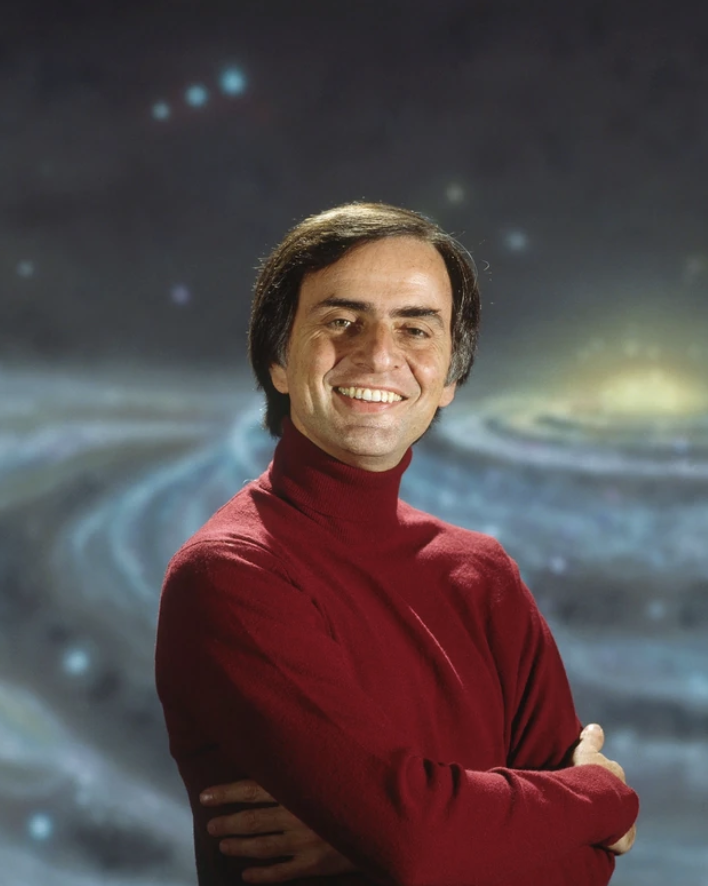
Carl Sagan was born in 1934. Sagan began working with NASA in the 1950s; he even briefed the Apollo astronauts before their mission to the moon. He worked in astrophysics at UC Berkeley, Harvard, and the Smithsonian before moving to Cornell in 1968, when he became the director of Cornell’s Laboratory for Planetary Studies. He became a full professor in 1971, and worked there until his death in 1996 at the age of 62 from pneumonia, a complication of a bone marrow disease.
He consulted with NASA and at the Jet Propulsion Laboratory (where Voyagar was based) throughout his career. He was one of the foremost astrophysicists of his time (and of ours), but also courted controversy by being interested in the possibilities of extraterrestrial life. He was also a major force for popular science; he wrote nonfiction science books about astronomy, astrobiology, and our own planet, including Dragons of Eden, which explored the evolution of human intelligence and won the Pulitzer Prize in 1977. In 1987, he wrote the science fiction novel Contact, which was a bestseller and made into a movie with Jodie Foster shortly after his death. He also had a very successful show called Cosmos that made him the face of astronomy for the everyday American. His enthusiasm and ability to translate complicated scientific fact and language into direct, emotional appeals to the human heart (as with the Pale Blue Dot — more in the next module) made him an enormously popular figure. He said “Imagination will often carry us to worlds that never were. But without it we go nowhere.”
One of the things we love most, though, is how his love story intersects with the Golden Record.
A primary member of the committee Carl Sagan assembled for creating the Golden Record was Ann Druyan, who came on as creative director for the project and oversaw the collection of material. Ann and Carl were friends and valued professional colleagues for years — nothing more.
One day, Ann finally found a piece of music she’d been searching for to put on the record, a 2,500-year-old piece of folk music from China called “Flowing Stream.” She called Carl to let him know. Over the course of that one single phone call, they fell in love “for keeps” and got engaged. “It was this great eureka moment. It was like a scientific discovery,” Ann said. They announced their engagement two days after Voyager launched, and they were together until Carl died.
A few days after that phone call, Ann went to Bellevue to have her brainwaves and heartbeat recorded to be encoded onto the Golden Record. She meditated for an hour, part of which was spent thinking about the wonder and sensation of being in love, and the data gathered was indeed included on the record. Carl Sagan and Ann Druyan’s love is very literally traveling through space and time at thousands of miles an hour, forever.
Learn More:
Ann Druyan’s interview about their love story
More about Carl Sagan and his work
Pale Blue Dot
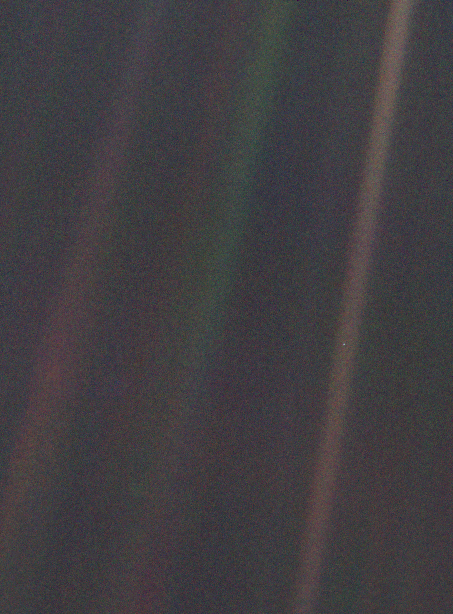
Carl Sagan campaigned for almost a decade to get NASA to allow them to turn Voyager 1’s camera around on its way past the outer planets in order to take a picture of Earth from so far away. NASA didn’t see the scientific benefit of going through all the trouble to keep the craft’s cameras working and to turn them toward us — there was no scientific information to gather. But Sagan and other scientists on the project believed in the emotional impact, and they finally persuaded NASA. On February 14, 1990 (Valentine’s Day, in this play “about love,” per Ian Kershaw!) Voyager 1 turned its cameras and took a series of 60 images of the solar system from beyond Neptune’s orbit, 4 billion miles from the sun. It captured all but Pluto (too far), Mars (obscured by sunlight), and Mercury (too close to the sun). These were the final images Voyager took — the cameras were shut down to save energy after sending back these images.
Candy Hansen-Koharchek, one of the imaging scientists, was the first to spot Earth in the image; it was sitting in a ray of light that nearly obscured it. She got to call everyone else to deliver the news that she’d found it. Another imaging scientist reports trying to brush dust off the image, only to realize she was trying to brush Earth. Sagan was write about its impact — the “Pale Blue Dot” became a compelling metaphor in his work for our global community, as well as the need to take care of our home.
“Look again at that dot. That’s here. That’s home. That’s us. On it everyone you love, everyone you know, everyone you ever heard of, every human being who ever was, lived out their lives. The aggregate of our joy and suffering, thousands of confident religions, ideologies, and economic doctrines, every hunter and forager, every hero and coward, every creator and destroyer of civilization, every king and peasant, every young couple in love, every mother and father, hopeful child, inventor and explorer, every teacher of morals, every corrupt politician, every “superstar,” every “supreme leader,” every saint and sinner in the history of our species lived there — on a mote of dust suspended in a sunbeam. The Earth is a very small stage in a vast cosmic arena. Think of the rivers of blood spilled by all those generals and emperors so that, in glory and triumph, they could become the momentary masters of a fraction of a dot. Think of the endless cruelties visited by the inhabitants of one corner of this pixel on the scarcely distinguishable inhabitants of some other corner…It has been said that astronomy is a humbling and character-building experience. There is perhaps no better demonstration of the folly of human conceits than this distant image of our tiny world. To me, it underscores our responsibility to deal more kindly with one another, and to preserve and cherish the pale blue dot, the only home we’ve ever known.” – Carl Sagan
The Kakudmi
The Forshaws’ Kakudmi is a reference to what many consider the oldest time-travel story — a story from Hindu mythology from the Mahābhārata, among other texts.
King Kakudmi had a daughter, Revati, who was so beautiful and so accomplished that no man on earth was worthy of her. To help choose a husband, Kakudmi and Revati traveled to seek an audience with Brahma, one of the three supreme deities, to ask his guidance on the top candidates for marriage. Brahma was listening to celestial musicians and so they waited. By the time he was done and Kakudmi had asked his advice, Brahma informed his human visitors that many ages had passed on Earth, despite it feeling like just a few minutes in Brahma’s realm, and all the candidates and their descendents were long gone.
When Kakudmi and Revati returned to Earth, everything was different. Brahma informed them that Vishnu (another supreme deity) was on Earth in the form of two brothers, Krishna and Balarama. He suggested that Balarama would be a suitable match, so Revati married Balarama and Kakudmi went into the Himalayas to meditate for the rest of his life.
This is one of the earliest stories of time dilation and time’s relativity, first told thousands of years before Einstein’s famous theory of relativity.
Learn More:
Read two versions of the story